Cry of the Xcluded rejects the 2026 Medium-Term Budget Policy Statement with contempt. It is a budget written for bankers, investors and the rich, delivered to a nation where hunger is at its worst since 2010 and 43.8% of people who want work cannot find it.
This is not a mistake. It is the same neoliberal programme of austerity, privatisation and market worship that has ruled Treasury for over a decade. The economy will grow by just 1.2% this year. Real public spending per person has fallen by about 23% since 2019/20. Yet the Minister now promises to keep building budget surpluses until 2030. Surpluses until 2030 mean austerity until 2030.
A windfall for bankers while children starve
Treasury collected R70.8 billion more in tax than it expected. Not one rand of that windfall goes to ending hunger. It goes straight into the pockets of bankers and lenders.
Meanwhile, the Social Relief of Distress grant is worth less than half of the Food Poverty Line, and its 8 million recipients get no inflation increase. Another 10 million people who qualify are shut out by punitive application rules. More than a quarter of our children are stunted.
The Social Relief of Distress grant has been left to rot. When it was introduced in 2020, it was R350 a month. Today it is R370, but inflation has eaten away at its value: measured in 2020 prices, it is now worth less than R271. In real terms, the poorest people in our country are receiving almost a quarter less than they did in the depths of the COVID-19 crisis. No one can feed themselves on that. Yet the Minister, sitting on a R70.8 billion tax windfall, could not find a single rand to increase it.
Worse, the Minister is funding his “new” programmes by purging the poor from the grant system. The R13 billion he calls “savings” from verification is, in reality, grants cut off. In February alone, SASSA suspended 85,222 grants for “failure to review”, most of them child support grants. Only 591 were stopped because the person failed the means test. At the same time, 4,323 suspected ghost workers on the public payroll keep drawing salaries while Treasury “investigates”. Poor mothers lose R580 a month on a technicality; suspected ghosts keep getting paid.
The R1.6 billion for stunting is taken from these same grant cuts and spread over three years: about R9 per child per month. The government is taking food from children to pay for a programme to feed children.
A generation thrown on the scrapheap
Right now, hundreds of thousands of young people are writing their matric exams, and thousands more are finishing college and university. They have done everything they were told to do. Most will walk out of the exam room into nothing: no job, no apprenticeship, no future the state is prepared to pay for. Unemployment stands at 43.8%, and for young people it is far worse. The MTBPS has nothing to say to them.
The jobs bloodbath continues
The bleeding has not stopped. Steel mills, ferro-alloy smelters and car plants are shutting their gates, and 210,000 jobs were lost in manufacturing and public services in the past year alone. Every closure kills the livelihood of a whole town. Government is impervious. The Department of Trade, Industry and Competition gets no new money, real funding for industrialisation will fall by 13.4% by 2030, and public employment programmes get nothing new.
Insource the workers, make the state work
The state is short of at least 190,000 public servants while clinics, schools and municipalities fall apart. Instead of hiring, Treasury tells departments to push experienced staff into early retirement and replace them with cheaper juniors. Meanwhile, municipalities and departments pay labour brokers and private contractors for cleaning, security, maintenance and other core work at higher cost and on poverty wages. Insourcing these workers on permanent contracts and decent wages would build a state that works and put money back into working-class communities. Instead, money is wasted on tenders with the inevitable resulting flow of corruption.
Climate jobs: build homes, build transport, build the future
The climate crisis is already here, in floods, droughts and heatwaves that hit poor communities hardest. Yet the MTBPS has no plan to adapt, and no plan for the jobs a just transition demands. The housing backlog runs into millions of families, while the Department of Human Settlements has delivered just 13,000 of the 62,000 houses it promised this year. A mass public housing programme, using local materials and local labour, would house families, revive construction and steel, and create jobs in every town.
The same is true of public transport. Workers lose a huge share of their wages travelling to work in unsafe, expensive and unreliable transport. Real public transport, with working passenger rail, public buses and affordable fares, would cut costs for workers and emissions for the planet.
This is not charity. Public investment in housing, transport and climate adaptation creates jobs, puts wages in people’s pockets and returns more to the economy than it costs. It is the austerity of the MTBPS that South Africa cannot afford.
That is why Cry of the Xcluded demands:
- The Right to Work in the Constitution, obliging the state to guarantee a decent job to everyone who wants one.
- A publicly driven programme for a million climate jobs, in mass housing, public transport, renewable energy, water and climate adaptation.
The money is there
Treasury says there is no money. That is a political choice, not a fact. As the Alternative Information and Development Centre (AIDC) has convincingly shown, the money is there to meet the immediate needs of the millions suffering. A wealth tax on the richest 1%, an end to illicit financial flows and profit shifting, fairer taxes on dividends and the highest earners, and an end to tax breaks that favour the wealthy, drawing on the surpluses in the Government Employees Pension Fund (GEPF), could raise close to R300 billion a year.
This is enough to raise the SRD grant to the Food Poverty Line, fund a million climate jobs, and fill the posts our clinics, schools and municipalities desperately need. Instead, the Minister chooses to protect the rich and reward the lenders.
This government is playing with fire
When a state abandons millions of people to hunger and joblessness while dancing to the tune of investors, bankers and the wealthy, it creates a vacuum. Reactionary groups like March and March are filling it. They take the real anger of the disillusioned and abandoned, and turn it against migrants and the poorest of the poor.
Migrants did not deindustrialise our economy, cut our grants or hand our tax windfall to the bankers. Treasury did. Every budget that chooses the markets over the people pours fuel on this fire. Government cannot claim to oppose xenophobia while its economic policies feed it.
Our march showed the power of unity
On Wednesday, unemployed people, workers, grant recipients and community activists marched on Parliament as the Minister delivered his statement. The march was a resounding success. People’s movements and labour stood side by side; urban and rural stood together, youth and the elderly marched as one. Unity became the dominant theme of our march and protest.
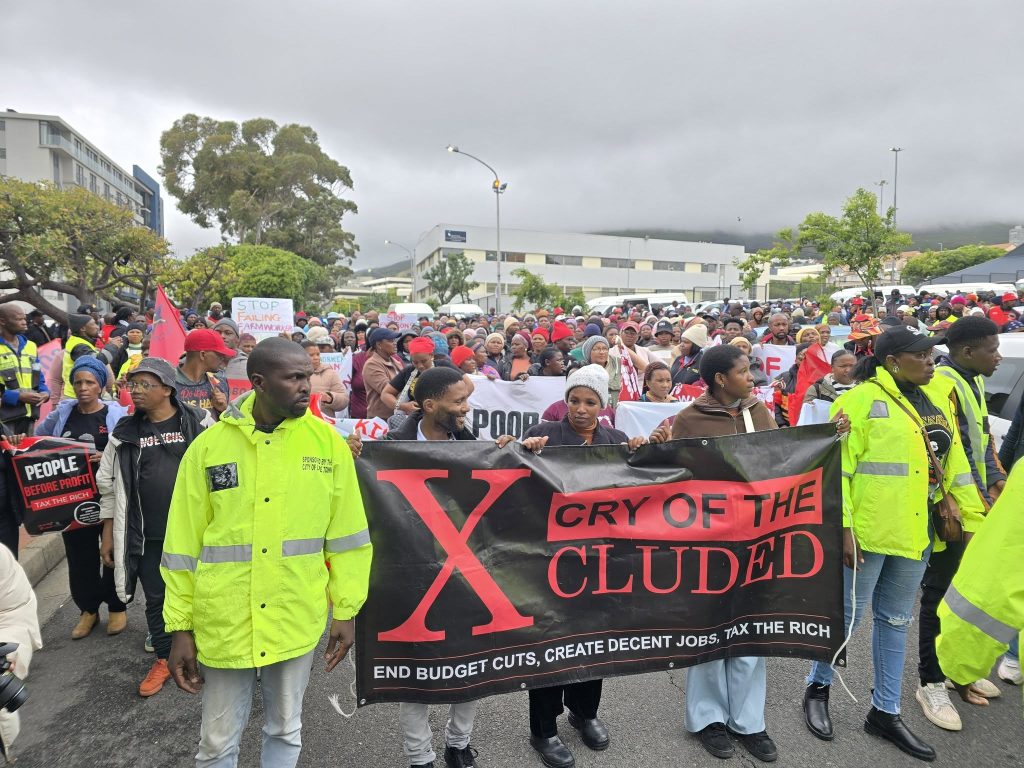
The unity on display was remarkable. Speaker after speaker made the same point: the employed and the unemployed face one enemy, an economic system that serves capital and discards the people. Our anger will not be turned against each other or against our neighbours. It will be organised.
We will shut the economy down
Cry of the Xcluded will spend the coming months organising in every community where people are hungry and without work. Together with the labour movement, we will build towards a massive national protest and an economic shutdown when the Minister returns to present the national Budget in February 2027, as part of a programme of rolling mass action.
We demand:
1. An immediate increase of the SRD grant to at least the Food Poverty Line, and an end to the purging of grant recipients.
2. The Right to Work in the Constitution, a publicly driven programme for a million climate jobs, and the insourcing of workers to fill the 190,000 missing posts in our public services.
3. A wealth tax on the richest 1% and an end to illicit financial flows and profit shifting.
4. The use of windfall revenue to end hunger, not to pay the bankers.
5. An end to privatisation, public-private partnerships and smart meters that cut poor households off from basic services.
6. Properly funded municipalities that deliver free basic services to every household that needs them.
The Minister has chosen the bankers. We choose the people. See you in February.
Issued by Cry of the Xcluded